
Belgium must catch up on fiber optic deployment, yet at Stratec, we regret that the subject remains largely absent from media discussions and among national and regional political leaders.
Over the past year, remote work has made considerable and rapid progress. At Stratec, as in other organizations, the majority of employee work hours are now completed outside our offices, and internal or external meetings are conducted via video conferencing. Most of our pre-March 2020 travel has been replaced by digital communications transmitted via cables, making us more dependent than ever on the quality of our internet connections.
Proximus announced at the end of 2020 its intention to accelerate fiber optic deployment. This is good news, but it comes very late when comparing Belgium’s situation to that of our European neighbours.
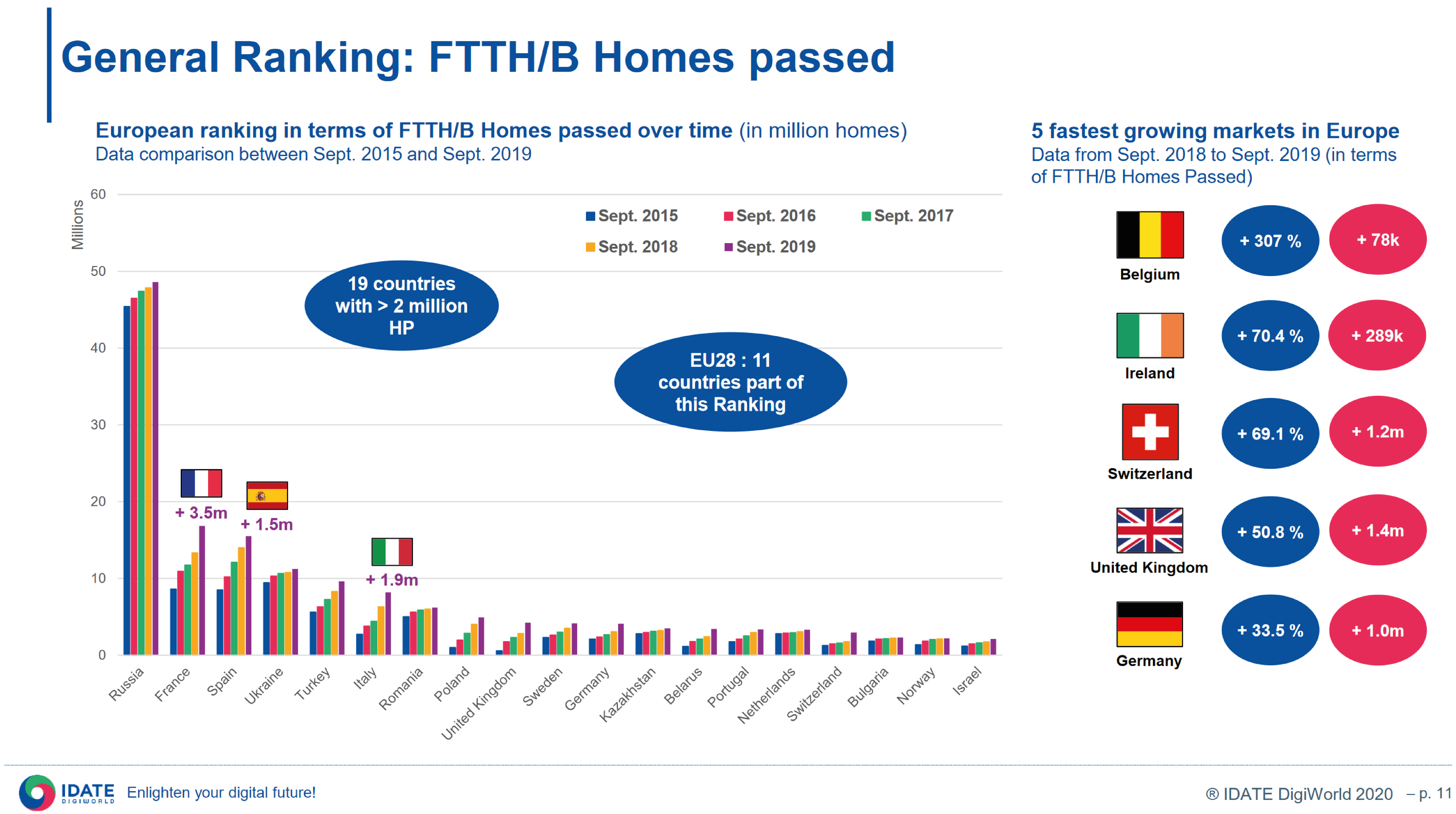
In April 2020, IDATE, a private think tank focused on digital issues, presented the progress of fiber optic deployment in Europe during a webinar. Their presentation indicates that, for the period from September 2018 to September 2019, Belgium recorded the fastest fiber optic deployment in Europe: +307%, representing 78,000 fiber optic connections in one year (see excerpt below).
One might initially be pleased, but this significant relative growth is primarily attributable to a very low starting point. It is considerably easier to quadruple a small figure than to double a large one. By comparing the absolute values presented by IDATE to the market size of these five countries, one quickly grasps Belgium’s lag in this domain. The following graph, prepared by Stratec, illustrates the number of fiber optic connections relative to the population size and the number of households in the five countries concerned. The result requires no further comment.
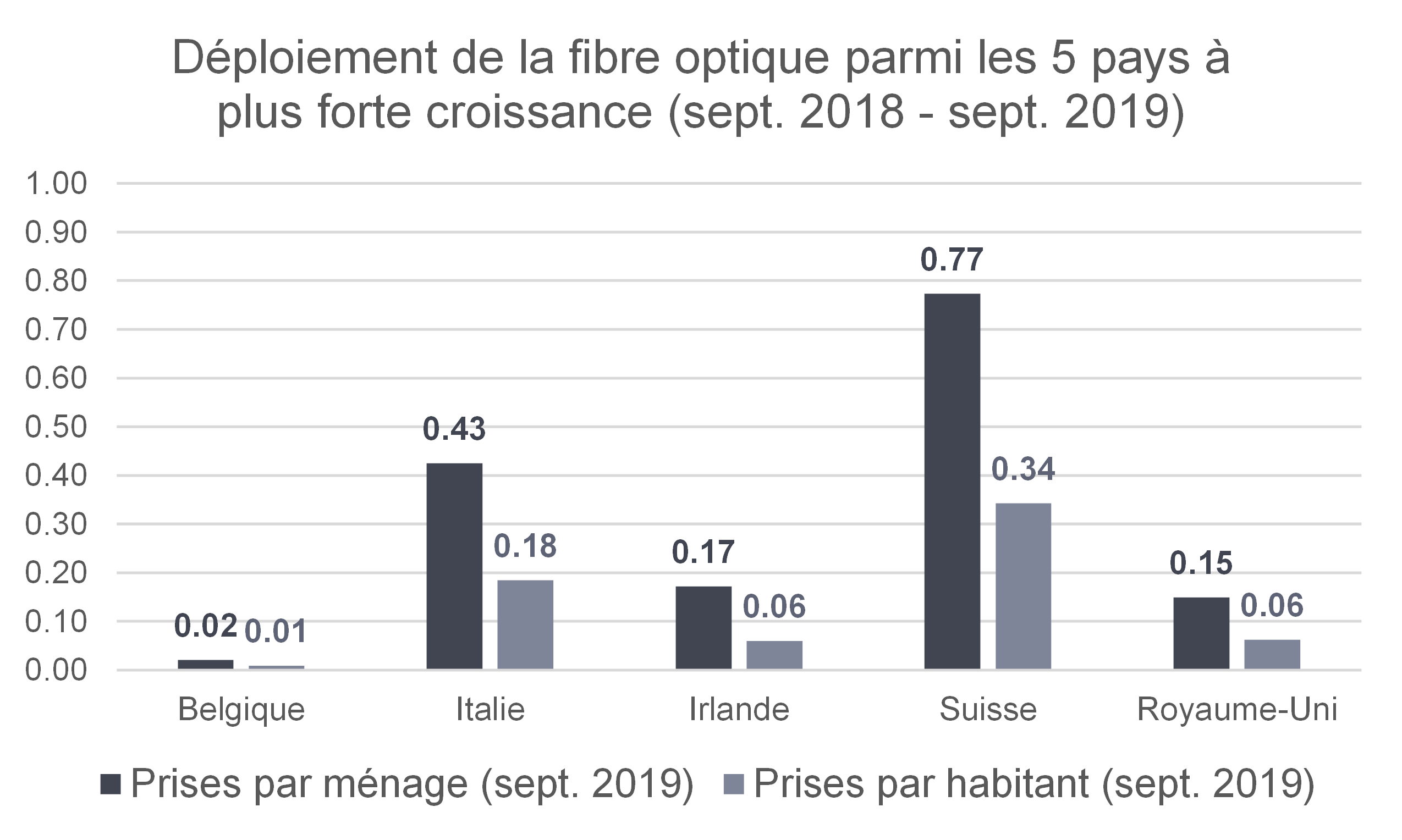
Note: In reality, company offices and commercial premises are also included, but the purpose is simply to compare the progress of different countries.
Thus, in 2020, less than 10% of Brussels households had access to fiber optics. For comparison, 85% of residential and professional premises in Greater Paris are reportedly already connectable to fiber optics. France had established a plan for very high-speed internet deployment as early as 2013. Today, 36% of internet subscriptions in France involve very high-speed connections, according to Arcep (the Electronic Communications Regulatory Authority). Yet, France is far from being a leader in Europe. As is often the case with digital matters, Nordic countries are at the forefront: the proportion of buildings reached by fiber optics stands at 98% in Iceland, 96% in Latvia, and 90% in Norway, compared to only 57% in France.
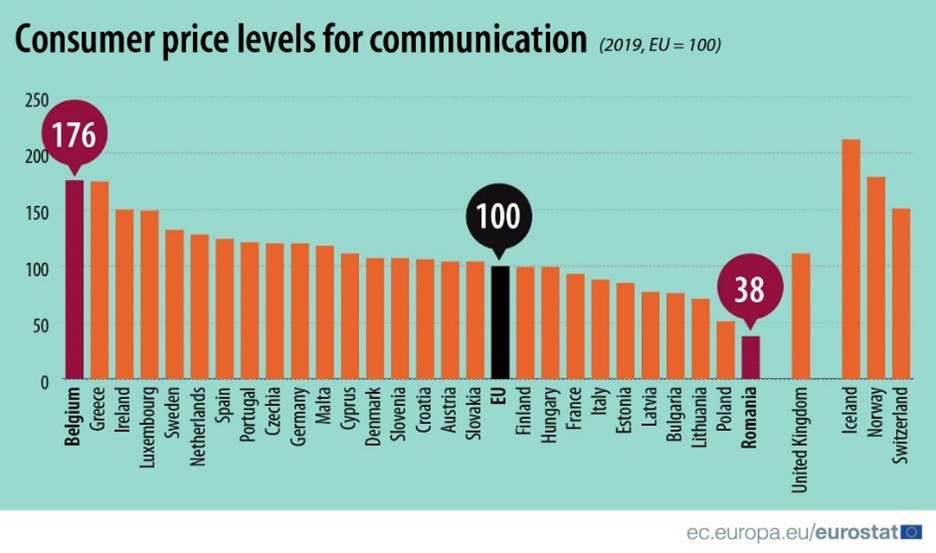
Compounding this delay, which is common to all three Belgian regions, is the fact that Belgium also exhibits the highest telecommunications prices in the European Union, according to Eurostat. This situation is particularly concerning given that it is largely overlooked by the country’s media and political leaders.
Belgium’s recent economic recovery plan heavily prioritises traditional infrastructure (60% of the budget), reportedly even including the renovation of the Brussels Palace of Justice. As a mobility consulting firm, Stratec is naturally pleased to see mobility projects, such as the Liège tram, receive a boost. Nevertheless, it is regrettable that digital technology ranks so low among public policy priorities in 2021. While the recovery plan does allocate a portion to digital transition, as mandated by the European Commission, these matters appear to be secondary to long-standing projects that Belgian institutions consistently struggle to fund.
In 2018, Stratec assessed, on behalf of Sofico (the Walloon public company managing motorway and waterway infrastructures), the socio-economic benefits derived from connecting approximately one hundred Walloon industrial zones to the fiber optic network. The estimated socio-economic gains for the economy, and society as a whole, then significantly surpassed the benefits typically achieved from transport infrastructures. One year after the onset of the unprecedented crisis caused by the COVID-19 pandemic, should we not empower ourselves to communicate more effectively to maintain competitiveness and potentially reduce travel?
Cover photo credit: BELGAIMAGE